What is clock?
A Clock is a device that tells us time of the day and night. Time on the clock is read from the printed numbers. The rotating needles are fixed at its centre point and always points to a number on it. So, the time can be noted down at any instance by observing on which numbers the rotating needles stays. Wrist watch or a clock hanging on the wall are some examples of clock.
Types of clock
In daily life we can see majorly two types of clock.
- Analogue clock
- Digital clock
Analogue clock
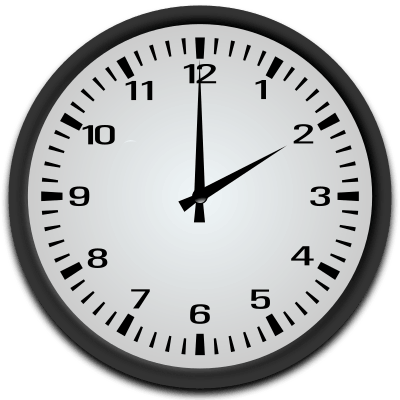
Analogue clock is a clock with revolving pointers or hands. On the clocks, there can be two or three hands to read hours, minutes and seconds.
Digital clock
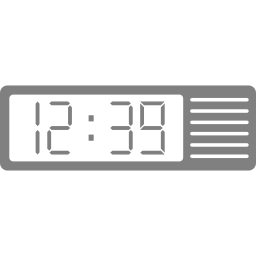
Digital clock shows time without using any hands like analogue clock. The time is shown only in the form of digits. Hours are shown first and then minutes, seperated by a colon (:).
Parts of analogue clock
Mainly a clock has two parts hands of the clock and clock face or dial.
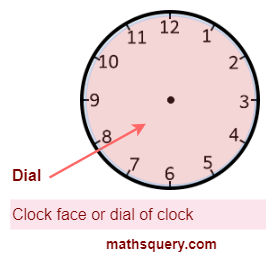
Clock face or dial
The part of the clock where numbers are printed and three hands of the clock are revolving continuously, is
called clock face or dial.
The dial has numbers printed from 1 to 12 which
represent hours. There can be another separate sequence of numbers printed on the dial such as 1 to 60 which
are used to note down both minutes and seconds.
Hands of clock
Rotating needles or pointers are called hands of clock which revolve on top of the dial. There are three types of rotating needles or hands on a dial.
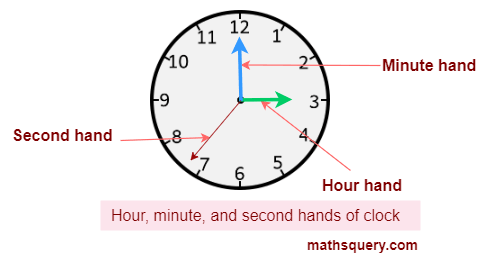
- Hour hand
- Minute hand
- Seconds hand
Hour hand
The hand with the shortest length is called as an hour hand. Hours are read using hour hand of the clock.
To note hours, position of the hour hand is observed.
The noted hour is then suffixed with o’clock.
The hour hand takes one hour to move from one number to the next number that represent hours.
Case 1: Hour hand exactly on hour
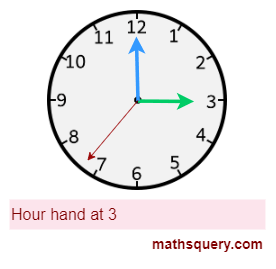
If it lies directly on any hour from 1 to 12, then exactly that number is read from the clock.
If the hour hand points directly to any hour from 1 to 12 written on dial and the minute hand is
on 12 also then it is a complete hour.
Example 1: Hour hand at 3 nad minute hand at 12
Case 2: Hour hand points between two hours
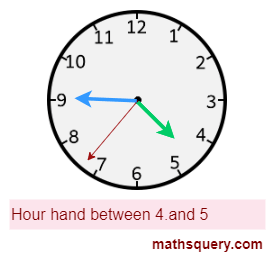
Another case is when hour hand does not lie exactly on the hour hand but lies in between two hours. Then then
hour which comes before the hour hand is noted down.
Example 2: Hour hand between 4 and 5
Hour hand takes 12 hours to complete one revolution.
Minute hand
The hand which is longer than the hour hand is called minute hand. It tells minutes of time. Generally, minutes are printed on dial with numbers from 1 to 60.
Unlike hours, minutes on the clock are read exactly where the minute hand points to. The clock is divided into 60 smaller units, and each smaller unit represents one minute. When minute hand moves from number to another number, it shows 1 minute have passed.
It takes 1 minute to move from one number to the next adjacent number, for example in moving from 15 to 16.
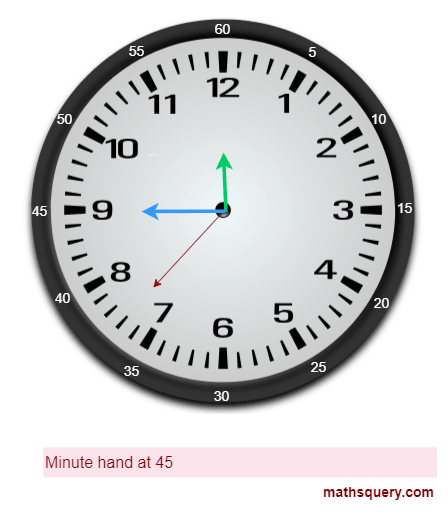
Example 1: Minute hand at 45
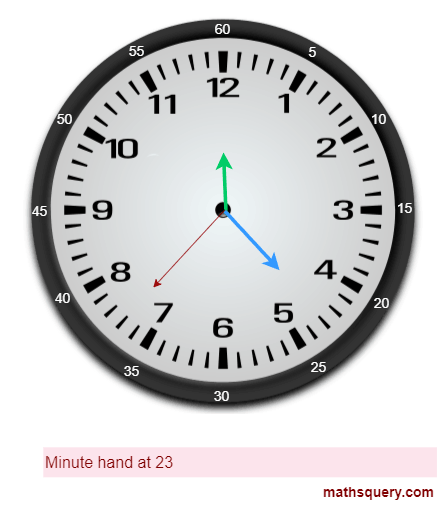
Example 2: Minute hand at 23
Minute hand takes 60 minutes to complete one revolution.
Second hand
The second hand can be recognised on the dial as the thinnest and the fastest running needle among hour and minute hands. The second hand also uses the same numbers marked on dial which are used to tell minutes. Seconds from the clock are read exactly where the second hand lies.
It takes 1 second to move from one number to the next adjacent number, for example in moving from 10 to 12.
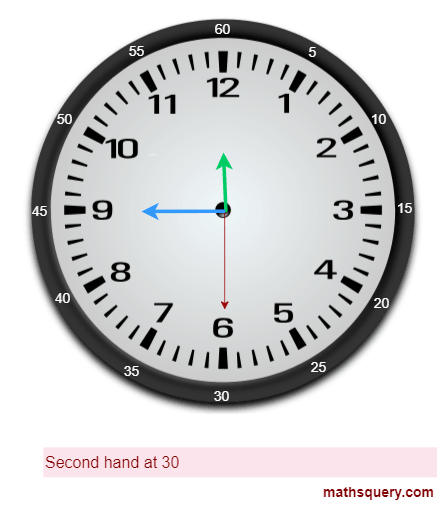
Example 1: Second hand at 30
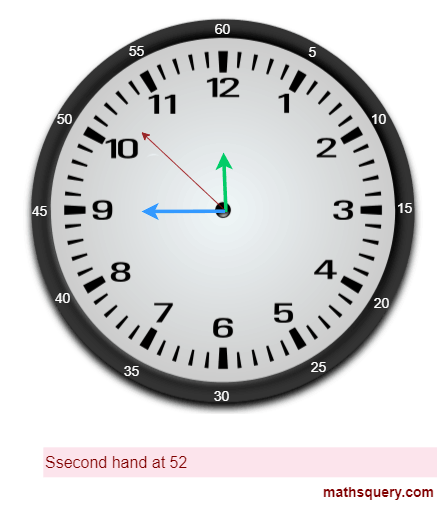
Example 2: Second hand at 52
Second hand takes 60 seconds to complete one revolution.
Read past of hours
Past of hours generally indicate there are more minutes in addition to the hour. It can be
minutes past or half past or quarter past that are prefixed to the hour noted.
Past of hour can be written with any minute that falls between 1 minutes and 30 minutes.
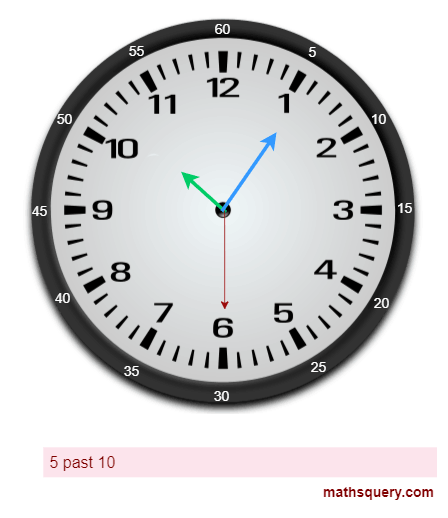
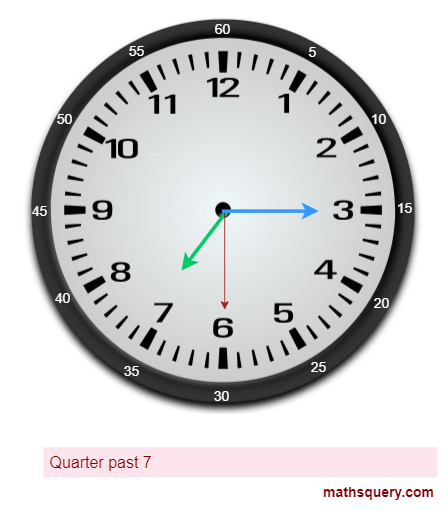
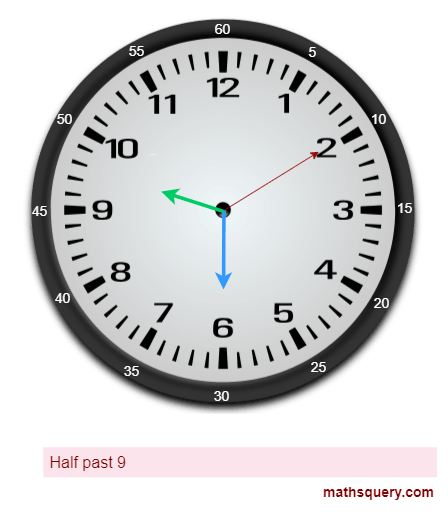
Example of past hours are 5 past 10, quarter past 7 or half past 9.
When position of the minute hand is on the right half side of the clock, it is “past the hour”.
Minutes past
Example 1: 5 past 10
Here 5 is the minutes and 10 is the hour.
So, the position of minute hand is exactly at 5 minute and 5 lies between 1 and 30 on the dial.
Quarter past
In Quarter past, quarter means 15 minutes and past is again a time that is counted after the hour noted from the hour hand.
Example 2: Quarter past 7
Here minute hand is at 15 and hour hand is at 7.
So, the position of minute hand is at between 1 and 30.
Half past
In Half past, half means 30 minutes. Additional 30 minutes are added to the hour.
Half past 9
Hour hand is at 9
Minute hand is at 30 minutes
Read to hours
Minutes to hours indicate how many minutes are left for minute hand to reach 12 on the clock. Minutes those fall between 30 and 60 are written with minutes to the hour. In this case, instead of the current hour, the next hour is written prefixed with to hour.
When position of the minute hand is on the left half side of the clock, it is “past the hour”.
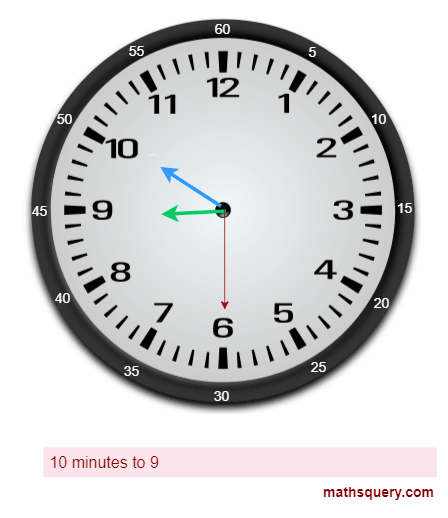
Example of to hours are 10 minutes to 9, 35 minutes to 2 or quarter to 11.
Minutes to hours
Example 1: 10 minutes to 9
10 minutes left for minute hand to reach 12.
The current hour is 8 and the next hour is 9.
So, to write time in this format, the next hour 9 is noted down prefixed with “10 minutes to”.
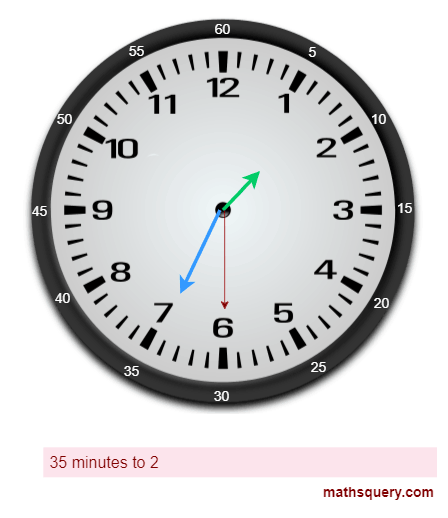
Example 2: 35 minutes to 2
35 minutes left for minute hand to reach 12.
The current hour is 1 and the next hour is 2.
Quarter to hours
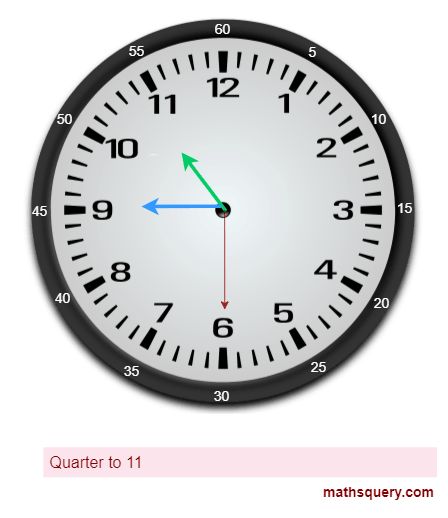
Quarter to hour means there are 15 minutes left to reach the next hour. Quarter minutes are 15 minutes.
Quarter to 11
This example shows that 15 minutes are left to reach 11 o’clock
Is it a.m. or p.m. on the clock?
The time that lies between 12 midnight and 12 noon is called as a.m. i.e. “Ante Meridiem”.
The time between 12 noon and 12 midnight is called as p.m. i.e. “Post Meridiem”.
In both a.m. and p.m., the hour hand starts its revolution from 12 and finishes at 12 again. It will be one revolution of hour hand, which counts to 12 hours.
Example 1:
The train starts its journey from London at 8 a.m. It means 8 o’clock in the morning.
Example 2:
I come back from school at 4 p.m, it means 4 o’clock in evening.
How to read time on clock?
In day to day conversations, time is spoken in the format, such as:
- quarter to 3
- quarter past 4
- 6 o’clock
- 10 past 4
- 10 minutes to 3
- half past 2
Formally or in writing the time is noted down from the clock consists of hour, minutes and seconds. Most of
the time seconds are ignored while telling the time.
The format to write time is hours : minutes : seconds. Remember to separate hours, minutes and
seconds by colons.
When seconds are ignored, then time can be written without mentioning seconds hours : minutes.
This format of writing time is also known by Digital format.
12 hour time format
When the time is just shown from 1 to 12 in digital format then to differentiate the time of day and night, a.m. or p.m. is suffixed.
- 09:45 p.m.
- 01:10 a.m.
- 06:36 p.m.
24 hour time format
The time after 12 noon are shown on digital clocks using digital format by further counting hours from 13 to 24 hours. This format is called 24 hour format.
- 21:45
- 01:10
- 18:36
What is a day?
A day consists of 24 hours.
Collectively, total number of hours of a.m. and p.m. make 24 hours i.e. 12 + 12 = 24 hours, which will be
one day. A day starts at 12 midnight and ends also at 12 midnight.
An hour hand makes two rounds in a day of 24 hours.
Fill in Blanks Worksheet
| Type: | Blanks |
| Count: | 1 |
- The long hand of a clock is called ___________ hand.
- A day has ___________ hours.
- The short hand in the clock makes ___________ complete revolutions in 24 hours.
- The time between midnight at 12 and noon at 12 is called ___________.
- The quarter past 5 in the evening is written as ___________ p.m.
- 8:45 is read as quarter to ___________.
- 11:30 is read as half past ___________.
- 16:45 can be written in 12 hour format as___________ p.m.
- There are ___________ minutes left to reach 2 o'clock, if the time noted from the clock is 20 minutes to 2.
- The time on the clock is 1:___________, if it is 25 past 1.


Solve Questions Worksheet
| Type: | Solve Questions |
| Count: | 1 |
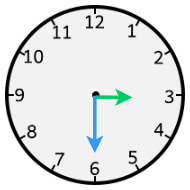
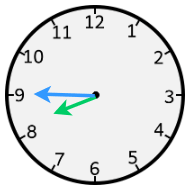
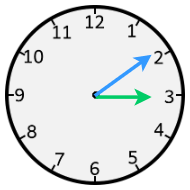
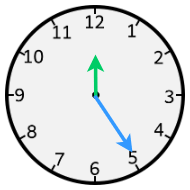
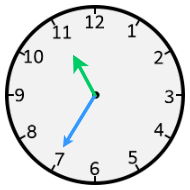
Write the time on clocks in words.
| 1) |
|
___________ |
| 2) |
|
___________ |
| 3) |
|
___________ |
| 4) |
|
___________ |
| 5) |
|
___________ |